This blog is my place to vent and share resources with other parents of children of trauma. I try to be open and honest about my feelings in order to help others know they are not alone. Therapeutic parenting of adopted teenagers with RAD and other severe mental illnesses and issues (plus "neurotypical" teens) , is not easy, and there are time when I say what I feel... at the moment. We're all human!

Wednesday, October 25, 2017

Why Won't My Child Just Behave?!


Kids do well if they CAN. This has nothing to do with whether or not they want to. 
Our role is not to make him want to, he already does. Our role is to figure out what is getting in his way, and help him. Changing our focus to finding out what is challenging him, helps both the child and ourselves. - Dr. Ross Greene
FINDING THE JOY
I know that, for myself, understanding why my child is acting this way makes it feel a lot less like a personal attack. It's much easier to feel empathetic, and I'm less likely to be personally triggered by it. HOWEVER, just because I understand why my child is acting this way doesn't mean it doesn't drain my emotional reserves. To remain a calm, therapeutic parent (vs a raving lunatic) requires a ton of Self-Care.
(For help figuring out how to achieve this state, check out this post - Finding the Joy)

Identifying the Challenges 

We don't always know why children (especially children of trauma) act the way they do.  It’s possible that they just want to watch adults get all agitated, maybe they want adults to fight to distract them from the child (and thus avoid conflict), or maybe they're trying to recreate the chaos that their brains are used to and therefore it feels comfortable and familiar - often they were "pickled" in adrenaline (or alcohol) in utero... 


Trauma can cause significant delays in development (emotionally, socially, intellectually...).  Frequent moves and other traumatic life events can also cause delays or even get them stuck at the age the trauma occurred.  Emotionally "triggering" events can cause a child to regress to a much younger age.  Most kids with PTSD (and brain damage from RAD) have a tough time with processing, memory, object permanence, emotional regulation...  

Expecting a child to "act his/her age," can cause frustration and anger for both of you.

From age 2-6, children are in the "Pre-operations" stage which means they create meaning through fantasy.  They are very visual and must touch or feel everything.  

Object Permanence
Kids with arrested development at the Preoperational stage (which is common for children of trauma) are not able to understand how we can infer things without seeing them. If you can't see it, Mom, it didn't happen. You can't know.  

Let me say that again! If you didn't see it, you couldn't know!   (More posts on Object Permanence and Object Permanence (cont).} A child without a grasp of Object Permanence can feel that you are punishing them for no reason at all! 

  • Toddlers (~2 - 3 years)
    Toddlers don't play with other children, but instead, do what we call parallel play.  
  • Pre-schoolers (~3 - 4 years)
    It's not until empathy develops at age 3 or 4 that they start to be aware of their playmates' needs and feelings. 
    Having no Empathy means that prior to this age they don't understand that their actions (biting, hitting, yelling...) hurts others. When they're toddlers this is not such a big deal. When they are teens...
  • Early School Age (~5 - 6 years)
    Magical Thinking/ Distorted Reality - 
    Around age 5 or 6, children go through the "magical thinking" stage.  They can want something so badly that they believe it, so it is true. I firmly believe that they could pass a lie detector on this. It becomes their reality and I don't believe they even remember that wasn't how it happened.
     
    {This post has more info on brain development, including why kids Lie and Steal}

Concrete Operational Stage
6-10 years
Concrete/ Black and White Thinking – Children under the age of 10 are concrete thinkers, and their brain is not yet wired to grasp abstract concepts at all.  


I tend to try to teach using examples and analogies (especially when natural or logical consequences don’t work).  My kids could NOT get it. 
For example, if I used as an example how they handled or could have handled a previous issue, most of the time they were instantly triggered into “fight, flight or freeze mode” because they felt they were being punished for this past transgression.  If I tried using an example or analogy, like the “Boy Who Cried Wolf, ” they just couldn’t generalize it to the current situation. They had no idea why I was bringing it up.


Children with arrested development at the Concrete Operational Stage (which is common for children with trauma issues),
Are not able to learn from:
  • peer or parent role modeling (watching others to see how they handle situations)
  • natural or logical consequences
  • examples or analogies 
because often, they can't generalize one situation to another. 


Formal Operational Stage
12 years - young adult
Thinking becomes much more sophisticated and advanced. Kids can think about abstract and theoretical concepts and use logic to come up with creative solutions to problems. Skills such as logical thought, deductive reasoning, and systematic planning also emerge during this stage.


How We Handled Age-Appropriate Parenting:

I try to parent based on the child's emotional age 
Therapeutic Parenting Based on Developmental/Emotional Age
Explaining Age-Appropriate Parenting To Your Child

Age-Appropriate Therapeutic Parenting for the Adult Child


Trauma, especially Reactive Attachment Disorder (RAD) can cause permanent brain damage and the brain has to be taught how to work around it 

Discipline problems (noncompliance, misbehavior) occur when the caregivers have not structured the child's environment for success or when parents are inconsistent (expectations or consequences), non-responsive, or inaccessible. When adults adjust their behaviors and attitudes, often children with discipline problems can be brought under control in as few as 3 to 7 days.
Behavior problems on the other hand lie within the child. These are persistent behaviors that do not disappear even with the best parenting (although therapeutic parenting can help to control the behaviors). These can include impulsivity, inattentiveness, immaturity, and other behaviors and issues caused by trauma and mental health disorders - C-PTSD, RAD, ADHD, FASD, anxiety, brain injuries and other behaviors associated with missing capacities like object relations and empathy.
{Chap. 2 Discipline vs. Behavior Problems}

YOU CAN NOT EXPECT PUNISHMENT OR DISCIPLINE
TO "FIX" BEHAVIOR PROBLEMS!

Let me say that again.


YOU CAN NOT EXPECT PUNISHMENT OR DISCIPLINE
TO "FIX" BEHAVIOR PROBLEMS!


Having behavior problems is like being born with poor eyesight. No amount of punishment or control is going to fix this problem. Glasses will help. However, the parent will be responsible for taking the child for regular eye check-ups, teaching him/her how to care for the glasses, and restricting activities where the glasses are likely to break. 
The goal is that by the time the child is 18, he/she will be ready and able to take full responsibility for the care of his own eyes and glasses.


How We Handled Behavior Problems:

I try to remind myself that my kids are SCARED, and punishment for something that was out of their control is not just mean, it is pointless. 

As children emotionally heal, you will most likely start to see some improvement in behavior problems. Therapeutic parenting, Therapy, Structure, and Medications can help a child heal. In the meantime, we need to focus on taking care of ourselves so that we can help the child with healing. {Finding the Joy, Handling Continuous Traumatic Stress(CTS) - When Your PTSD is Not Post/Past Yet} 


I can hear you thinking, "My kid's behavior was horrible today! He doesn't deserve to go on a fun outing. He'll think he's won.
I get it, but he may not deserve it, but he needs it. We tried to balance this so it didn't feel like a reward and wasn't a "blank slate" (forget it ever happened). Plus, if we stayed home, or one parent stayed home, then the family couldn't go anywhere or do anything together.. because someone was always in trouble). 
Our solution? All the children were allowed to go on "family activities" (or if the activity was overwhelming or triggering for a child, we found something else for that child to do with a trusted adult). If the whole family was doing something together, like going to the park, or the movies, or out to eat... then the child could go. We wanted there to be obvious rewards to being part of our family.

Not Feeling Safe


Children NEED to feel safe to start to heal.   This feeling of safety is not about physical safety and often isn't based on reality – it is a perceived feeling of safety.


A child who feels unsafe is a scared child. A scared child will act out (or act in) to try to feel safe again.

Just like our kids keep using old defense mechanisms that are no longer needed, our kids with scary, traumatic early childhoods often get stuck in the feeling that they are not safe.


This is a life-or-death feeling! 


Feeling unsafe is not rational. You can't explain to the child that they're safe now. Logic doesn't work. Feelings of being unsafe can pop up at the most unexpected times (just like PTSD flashbacks can).  


Generally, this feeling of being unsafe will fade as our child heals, but there will probably always be times when it comes up again. For a good explanation of why kids with trauma issues don't feel safe see: The Frozen Lake Story (at the bottom of this post) by Nancy Thomas.

“Children who don't feel safe in infancy have trouble regulating their moods and emotional responses as they grow older. By Kindergarten, many disorganized infants are either aggressive or spaced out and disengaged, and they go on to develop a range of psychiatric problems. They also show more physiological stress, as expressed in heart rate, heart rage variability, stress hormone responses, and lowered immune factors. Does this kind of biological dysregulation automatically reset to normal as a child matures or is moved to a safe environment? So far as we know, it does not.” ~ The Body Keeps the Score, Beseel A van der Kolk, M.D.
For a fantastic explanation of safety and why it is so important - plus what to do about it, I highly recommend the video Chaos to Healing - Therapeutic Parenting 101 which explains Daniel Hughes P.A.C.E concept in an easy-to-understand and practical way. One of the presenters in this video is therapeutic parent and coach, Christine Moers. I HIGHLY recommend it.

War Zone

Children of trauma are often easily triggered, extremely sensitive to emotions, unable to regulate their emotions... causing them to react as if they are in a warzone.  You can't learn, attach, and heal if you don't feel safe and you're living in a war zone! 

How We Handled Not Feeling Safe: 


Our kids need to feel safe and loved. {Why Doesn't My Child Feel Safe?} 

That meant I couldn’t punish them by taking away all fun stuff (even though I wanted to!!!) {A post on Consequences vs Privileges}

Our kids NEED Rules, Structure, Support, Routines, and Boundaries to feel safe.


Additional Challenges:


Attention Seeking? 

At first, my daughter's nonsense questions and babbling about TV shows or the latest drama at school (things and people I know nothing and care nothing about), felt like she was trying to keep all the focus on her and/or drive me crazy. I found myself starting to avoid her. Then I noticed a pattern. When she was feeling anxious and overwhelmed, she started doing what my mom called "pressured speech." 


Nonsense chatter

I really can’t stop talking cos you might forget I’m here

It keeps your focus on me as I bend your weary ear

Lots and lots of nonsense questions

I just switch off from your objections


What’s the purple-ist purple that you have ever seen

What are we having for dinner and why is the grass green

I’m scared I’ll be invisible if I cease to babble on

I need to keep your interest to feel like I belong


I cannot sit here quietly cos of wobbles in my belly

So I make lots of noise and I interrupt the telly

What if you don’t feed me or make me go away

You’ll always know I’m here if I’ve got lots to say


It’s all about survival and making sure you’re near

The nonsense in my questions stem from all my fear

I know this drives you crazy and can make you feel insane

It all comes from my trauma and underdeveloped brain


I need your reassurance that you’ve not forgotten me

Let me know you’ll listen when you’ve finished cooking tea

Try to be more playful and say your ears are full

But they’ll be far more empty when I get home from school


If my questions are ridiculous, relay them back to me

It’ll interrupt my trauma and might be quite funny

Gently touch my shoulder and remind me that you’re there

Let me know you understand the need behind my fear


And lastly but not least, please do not forget

Developmentally I’m younger and my brain’s not caught up yet!


Sarah Dillon - National Association of Therapeutic Parents


How We Handled It

When I realized this behavior was caused by anxiety, it made it easier to provide Calming Techniques and fight to make her world smaller and less overwhelming (by providing Structure and Caring Support). 


Empty Bucket
It makes me crazy that my kids can behave all day at school, and then come home and be whiny, requiring my constant attention. be demanding (especially to me), picking fights, picking on siblings, getting into arguments with everyone, refusing to do even the simplest chore or task... {For more information about why they act this way, check out the post - If You Find Out I'm Not Perfect, You'll Leave.}

I believe that this is what happens with our children too. They work so hard behaving in front of other people, that when they get home, they have no emotional reserves (spoons) left. They trust us enough to let us see that they're not perfect 
{And yes, I often wish my kids didn't trust me this much! That's why I do a LOT of Self-Care!} 

My Spoon Theory
The original Spoon Theory is about a woman with Lupus explaining to a friend, that she gets a finite number of physical activities per day (represented by spoons) and that every task costs her one of her spoons. She often runs out of spoons before the end of the day. 

I believe that a lot of children of trauma have a similar issue, and "run out of spoons" by the end of the day (or well before the end of the day because unlike an adult, a child is unable to estimate how many spoons they have and regulate what to use them on.


But Things Were Going So Well!/ Regression

One step forward, two steps back. Our kids feel deep down that they are unworthy and unlovable. The child is terrified that if people found out what he/ she was "really like, " then they would leave him/ her. {If You Find Out I'm Not Perfect, You'll Leave.}

{When Kitty trusted me enough to admit this fear out loud, I think she was finally ready to start healing. I feel the best thing I did was reassure her that I already knew she wasn't "perfect" and I still loved her. That I wasn't going to leave because she didn't/ couldn't behave, and sometimes took joy in causing chaos.}


A kid who is doing well might suddenly seem to sabotage their success. Sometimes, I think when things are going too well, my kids get scared and pull back.


This could be due to:

  • A Traumaversary, Birthday, Trauma Trigger, Holiday, Change in Routine...
  • They "know" things are going to go wrong, so they self-sabotage things to take back control - by controlling when it happens it makes them feel in control and safe. 
  • The need to protect themselves from what they consider your inevitable rejection by rejecting/ pushing you away. 
  • They feel they don't deserve good things to happen to them.
  • They expect the other shoe to drop. Historically if good things happen to the child, they are followed by bad things (usually involving great loss) - so our kids avoid the good things to make losing them hurt less. 
  • They're afraid that if they're doing well, then you'll raise the bar on your expectations and expect them to keep it up (which is a lot of pressure).
  • They "know" they're going to mess up, so they go ahead and get it over with.
  • Good behavior often leads to higher expectations and more freedom and privileges. Privileges that the child may be afraid they can't handle (and actually may not be able to handle!).
    {Bear NEEDED a high amount of structure and support to feel safe - he did very well in a structured, supportive environment and there was a lot of pressure put on us as parents to "reward" that success by putting him in less restrictive environments - where he inevitably failed. I personally believe that failure was often (sub-conscious?) self-sabotage to get put back in the more restrictive environment.}

Small Window of Tolerance/ Easily Overwhelmed
Overreacting to things you or I might consider minor. 

Window of tolerance is a term used to describe the zone of arousal in which a person is able to function most effectively. When people are within this zone, they are typically able to readily receive, process, and integrate information and otherwise respond to the demands of everyday life without much difficulty. This optimal window was first named as such by Dan Siegel.
During times of extreme stress, people often experience periods of either hyper- or hypo-arousal.
  • Hyper-arousal, otherwise known as the fight/flight response, is often characterized by hypervigilance, feelings of anxiety and/or panic, and racing thoughts.
  • Hypo-arousal, or a freeze response, may cause feelings of emotional numbness, emptiness, or paralysis.
People who have experienced a traumatic event may respond to stressors, even minor ones, with extreme hyper- or hypo-arousal. As a result of their experiences, they may come to believe the world is unsafe and may operate with a window of tolerance that has become more narrow or inflexible as a result. A narrowed window of tolerance may cause people to perceive danger more readily and react to real and imagined threats with either a fight/flight response or a freeze response.
Dysregulation and Meltdowns
A child who is Dysregulated and/or in fight/ flight/ freeze mode is “thinking” with the reptilian part of the brain (survival!).  In other words, they are not thinking at all.
Their behavior is a purely instinctual response to what the brain believes is a life-or-death situation.

How We Handled Dysregulation: 
Helping my dysregulated child feel safe and calm was the best way to help them return to their window of tolerance. {See posts - Dysregulation and Meltdowns; Why Doesn't My Child Feel Safe?; Calming/ Relaxation Techniques}. 

I found that Structure and Caring Support was the most helpful long-term for helping them widen their window of tolerance.  

Complex Post Traumatic Stress Disorder (C-PTSD) 
Be prepared for your child to blame you for their past (usually, the mom gets the brunt of this). My daughter recently admitted to seeing one of her past abuser's face everywhere - on walls, and particularly - over my husband's face. She hates "him," rages at him, tells him he is mean and evil, accuses him of yelling at her (even though Hubby isn't even raising his voice), and she dissociates.

When in a meltdown, Kitty mentally shuts down - we call it "freeze." She acts instinctively to protect herself. It's difficult not to hold her accountable when she rages during these times, but we've learned to wait until she's calm and then process what led up to the event so we can help her prevent re-occurrences. There are times when she doesn't remember the event at all.


Kids in a PTSD flashback are overwhelmed and in fight/ flight or freeze. It’s difficult to learn math and spelling when you’re in the middle of a war zone! 


How We Handled PTSD: 

Get a good therapist who understands and has experience working with adopted/foster kids with trauma. We love our EMDR therapist for our daughter but still use a good attachment therapist too. Don't be afraid to "fire" the therapist if it's not a good personality match. {PTSD in Children}

EMDR therapy is the most recommended therapy for people with PTSD. It is most often used by soldiers and victims of trauma (like rape or being in a natural disaster), and usually only requires 2-3 sessions.  Obviously, people who have suffered from long-term trauma (Complex PTSD), such as child abuse, would most likely require more sessions.  


There are no Medications specifically for treating PTSD, but with good therapy and meds that help with the child's 
symptoms, the child can recognize the effects of the trauma, learn to cope, and move on to dealing with the cause of the trauma.


Holidays, Birthdays, School, and Other Traumaversaries

At our house, the acting out and meltdowns were always worse around Holidays, Traumaversaries, Starting or Ending school, Birthdays... When I wasn't so frustrated at them I could scream, I pulled them in. I reminded myself that they were terrified. This was life or death to them, and they couldn't really handle change or added stress (this has gotten better as they healed). Even my bio kids reacted this way, just not to this extreme. 
(Helpful post - Handling Meltdowns and Dysregulation)


Puberty

Puberty sucks. Those hormones rushing around adds a whole new layer of fun. The good news is that while ages 13 and 14 were horrible for my kids (both bio and adopted), things got better after that. 
More info in this post - The Teen Years


Co-Morbid Diagnoses

Children with trauma issues usually have more going on than just one issue - attachment disorders, physical and sexual abuse, PTSD, RAD bipolar disorder, ADHD, FAS/FAE... caseworkers will not or cannot tell you all of what caused these issues, and often symptoms overlap and appear to be other things. For example, I don't think I've ever heard of a child with RAD that didn't also have PTSD. 
{Overlapping Diagnoses in Children, Chart for Overlapping Behavior Characteristics.


Some Things That Helped Us Handle Behavior Issues


PRIORITIZING YOURSELF, YOUR FAMILY, AND YOUR CHILD - IN THAT ORDER!


MY TOP 10ISH THINGS I COULDN'T DO THIS WITHOUT


STRUCTURE AND CARING SUPPORT Helping your child feel safe by providing the structure they need/ crave. Most of all, I gave my kids a LOT of structure and support. {Structure and Caring Support} Our kids need so much more than other kids, especially when they are overwhelmed and Dysregulated. {Handling Meltdowns and Dysregulation}

We went back to line-of-sight supervision, time-ins instead of timeouts, removed as many overwhelming events as possible (not just avoiding throngs of people in places like sporting events and the park, but also places like the grocery store and Sunday School). Yes, there were things I could do little about (school/ daycare), but I could talk to the teachers and minimize as much stress as possible.

When stress was high, my kids’ life was like being in the FAIR Club (our family discipline method), but without actually being in the FAIR Club {Using the FAIR Club with Children of Trauma}

COCOONING
I tried to find calm, quiet, but still fun, things to do {Trapped in The House: Activities for Kids} so they wouldn't feel punished (taking a walk, letter parties … ). This wasn't about being in trouble or loss, they'd had enough of that; this was about making their life smaller. So they would feel SAFE.

SCHOOL
I worked with the school to try to find ways to reduce my child's stress there. {Anxiety Scale}

SIMPLIFY
At home, I did things like strip their room {Decluttering} because even with me helping them clean, it was overwhelming. So I did it when they weren't there, although I let them know ahead of time.  I left nothing but a bed, a book/ quiet toy, and a stuffed animal, at one point I even had my daughter's dresser in my room, and she "checked out" her clothing by bringing me the dirty ones, THIS WAS NOT A PUNISHMENT. I tried to find ways to help them understand that. For example, cleaning their room would be a lot easier now! (Explaining Age-Appropriate Parenting to Your Child), 


CALMING TECHNIQUES

Effective techniques for helping a child calm down or stay calm. I used Calming Techniques a LOT.

PLACE
Playfulness: Don't take our kids or our life so seriously. When things are tense find a way to lighten the moment. (NO SARCASM)
Love: Loving eyes, loving hands, loving voice. Never give up. Never quit.
Attunement: talking through problems and allowing yourself to become in tune with what your child is saying....no matter how ridiculous, follow the conversation. Be accepting as you move through the problem. (if you are uncomfortable with this, ask yourself how much good has come from trying to get them to admit they have done something wrong)
Curious about this ridiculous story and about what might be, about what might be hard to say, about what has happened? (I'm wondering if I had broken the lamp if I might be afraid to say so)
Empathy: I get how you feel. I feel what you feel. I see the sadness/fear in your eyes. I know it is hard to talk about big feelings.

For more about PLACE, check out this post: Creating PLACE: Parenting to Create a Sense of Safety by Daniel Hughes 


SELF-CARE!
A lot of time I screwed up. I lost my cool. I gave up.  Here's what I did to fill my empty bucket so I could handle my kids.


As the child heals and attaches to you, he/ she feels safer. Being a Therapeutic Parent SUCKS, but it does get better.

CRISIS PLANS

Setting up a plan with the child's school, caregivers, treatment team... to determine ahead of time, what to do if the child starts feeling unsafe and acting out or acting in.

ANXIETY SCALE 

A concrete method of determining how a child is feeling.

CONSEQUENCE vs PRIVILEGES 

Thinking outside the box (letting the kids help)

DEVELOPMENTAL AGE-APPROPRIATE LEVELS

A concrete plan used to explain to the treatment team why the child is being given privileges and responsibilities more appropriate to a younger child (hint: because the child is dysregulated and doesn't feel safe!)

THE FAIR CLUB - At first, we used the FAIR Club for discipline, but then we discovered that it could be used as a starting point for the structured lifestyle our kids with trauma issues needed.


BUILDING SECURE ATTACHMENT

Secure attachment requires the development of object permanence and constancy.

There are three basic steps to this process:

  1. Building Safety. You cannot attach or love if you do not feel safe. Safety for kids of trauma comes from routines and security (which can be things like physical holds and alarms on the door, but also regular meal and bedtime routines). Parents MUST provide for basic needs (food, shelter, warmth) routinely and predictably, BUT feeling safe takes time. It took many years for them to feel unsafe and not trust, You can't expect them to trust just because you know they're safe now. It takes time to unlearn those defense mechanisms that once were necessary for survival.  {Why Doesn't My Child Feel Safe?}
  2. Falling in Love. Dopamine is a brain chemical that makes everything seem more fun and interesting. We cannot fall in love without positive fun and interaction.

    Think about this. You would not walk up to someone and say, "Hey, what's your name? Hi Larry, you're going to be my new husband. You will live in my house, take my last name, and do all the chores on this honey-do list. You are not allowed to talk about your other life. Your wife was mean and she does not love you like I do. You love me and I love you.... say it! Say you love me!" ---------------

    ---------- Of course, you wouldn't do this! You get to know each other. You date. You have fun, conversations, and play together.
  3. Claiming and Belonging. This cannot come first! You need the other steps to come first. You also must honor the child's choice to be a member of the family or not and shift roles accordingly. 
Until a child is a member of the family they should receive "The Basic Package" accommodations.
  • Provide a "structure and rehabilitation" environment (vs. "love and affection" environment). {Structure and Caring Support}
  • Meet the child's basic needs for food, shelter, and warmth.
  • Provide affection in response to the child's demonstration of affection, but only if it's appropriate.
  • Draw attention to the "giving and taking" that is part of every interaction. {Reciprocity}
  • Give and allow consequences that will evoke caring behaviors. {Therapeutic Parenting and The FAIR Club}
Katharine suggests no chores or family expectations until your child is part of your family. Even the names "Mom" and "Dad" are nicknames that grow out of love and can wait until later to be used.

"The Luxury Package" Accommodation
Basic package plus "family perks"

  • All things that children don't need, but come out of the goodness of a parent's heart (ex. extra-curricular activities, chauffeur services, vacations, parties, dinners out).
  • To qualify for this package a child has to mutually satisfy parental needs in some ways, most of the time.
Earning the Luxury Package
A child can "upgrade" by performing certain family-friendly behaviors.
How do you know whether or not your child has given enough to deserve an upgrade and is ready to be part of the family?

Close your eyes and picture a child. How do you feel when you look at this child? Do you feel happy and loving? Do you feel warmth?
Any time you wonder if your child is ready, close your eyes and picture your child. Does the thought of your child make you feel warm and happy? A joy to your heart as opposed to sadness, emptiness, rejection, or fear? {Positive Behaviors}

Until the child makes you feel this way he or she is not ready to be part of the family. It cannot be earned or forced. It is a feeling.

A relationship is defined as a MUTUAL satisfaction of needs.
  • There is no mutual well-being if a parent is providing luxury accommodations and the child is not earning the perks.
  • The child will be momentarily happy (as long as the perks keep coming), but the parent will not.
  • The ramifications to your child's development and the parent-child relationship go much deeper than happiness.
So here's what happens:
  1. The parent receives little or no positive response from the child and often the child is neglectful of and abusive to the parent. Without either one's needs being met, and unable to "exit" the relationship, there can be little to no feelings of attachment (leaving resentment and apathy).
  2. The parent's natural frustrations, disappointments, feelings of being used up, resentments, and demands from the child... are viewed as weaknesses, even emotional disabilities (unresolved issues) that require therapeutic interventions. Therapists blame the parents for their bad feelings about the child or might switch to the more willing "client" ignoring the elephant in the room.... which causes a lack of faith in therapy for the parent.
  3. Everyone presumes that if the child's needs are met he or she will naturally begin to reciprocate. Loving the child and satisfying his or her needs is not enough. The child MUST be taught how to be in a relationship. 

ROLE MODELING DOES NOT WORK WITH OUR CHILDREN


WHAT I'VE LEARNED:
  • No matter how much healing my child does, if I've allowed myself to become completely drained, then I have no emotional reserves left. You can't fill from an empty cup. {Self-Care! Caring for the Caregiver!}
  • It took me a long time, but I finally realized I needed to change my priorities or I and my whole family would suffer. {Prioritizing Yourself, Your Marriage, Your Family, and Your Child - In That Order!} 
  • Understanding WHY my child is acting this way helps me be more empathetic and provide my child with the most effective support {Secure Attachment}
  • I'm working hard to remember that I didn't cause this and it most likely isn't "fixable," especially this late in his life. {You Haven't Failed }
  • Pouring everything I have into him doesn't work so I shouldn't feel guilty for not wanting to do it anymore. {Relationships and Relationships (cont.)}
  • I have a right to grieve the child/relationship I thought I was getting. {Finding the Joy}
  • He doesn't "deserve" all the privileges of being part of this family... they're hurting him not helping him. I need to provide the structure he actually needs and the caring support that I hope will lead to attachment. {Structure and Caring Support}
  • I need to set up fun times with positive interactions so we have the opportunity to fall in love instead of focusing on punishment and chores.
  • This post has more information about how the {Basic Plan vs Luxury (Family) Plan} looked as the kids moved into their late teens, and we decided to revisit it to remind them of the difference between living like a boarder vs the privileges that came with being part of the family. 

ADDITIONAL RESOURCES
 If You Find Out I'm Not Perfect You'll Leave 
Why Doesn't My Child Feel Safe?

CHRISTINE MOERS, therapeutic parent and coach. See her YouTube videos and check out her blog, CHAOS TO HEALING - Therapeutic Parenting 101 video which explains Daniel Hughes P.A.C.E concept in an easy-to-understand and practical way.


THE FROZEN LAKE STORY by Nancy Thomas
 "In order to understand what an unattached child feels like, one must understand his perspective. Imagine that you are the young child who must cross a frozen lake in the autumn to reach your home. As you are walking across the lake alone, you fall suddenly and unexpectedly through the ice. Shocked and cold in the dark, you can't even cry for help. You struggle for your very life, you struggle to the surface. Locating the jagged opening, you drag yourself through the air and crawl back into the woods from where you started. You decide to live there and never, never to return onto the ice. As weeks go by you see others on the ice skating and crossing the ice. If you go onto it, you will die."
"Your family across the pond hears the sad news that the temperature will drop to sub-zero this night. So a brave and caring family member (that is you, the parent!) searches and finds you to bring you home to love and warmth. The family member attempts to help you cross the ice by supporting and encouraging, pulling and prodding. You, believing you will die, fight for your life by kicking, screaming, punching and yelling (even obscenities) to get the other person away from you. Every effort is spent in attempting to disengage from this family member. The family member fights for your life, knowing you must have the love and warmth of home for your very survival. They take the blows you dish out and continue to pull you across the ice to home, knowing it's your only chance."
"The ice represents the strength of the bond and your ability to trust. It was damaged by the break in your connection to someone you trusted. Some children have numerous bonding breaks throughout their young lives. This is like crashing them into the ice water each time they are moved, scarring and chilling their hearts against ever loving and bonding again." 

Tuesday, October 3, 2017

Fetal Alcohol Spectrum Disorders (FASD)

Behavioral: Acting Younger than Chronological Age
Fetal Alcohol Spectrum Disorders (FASD)

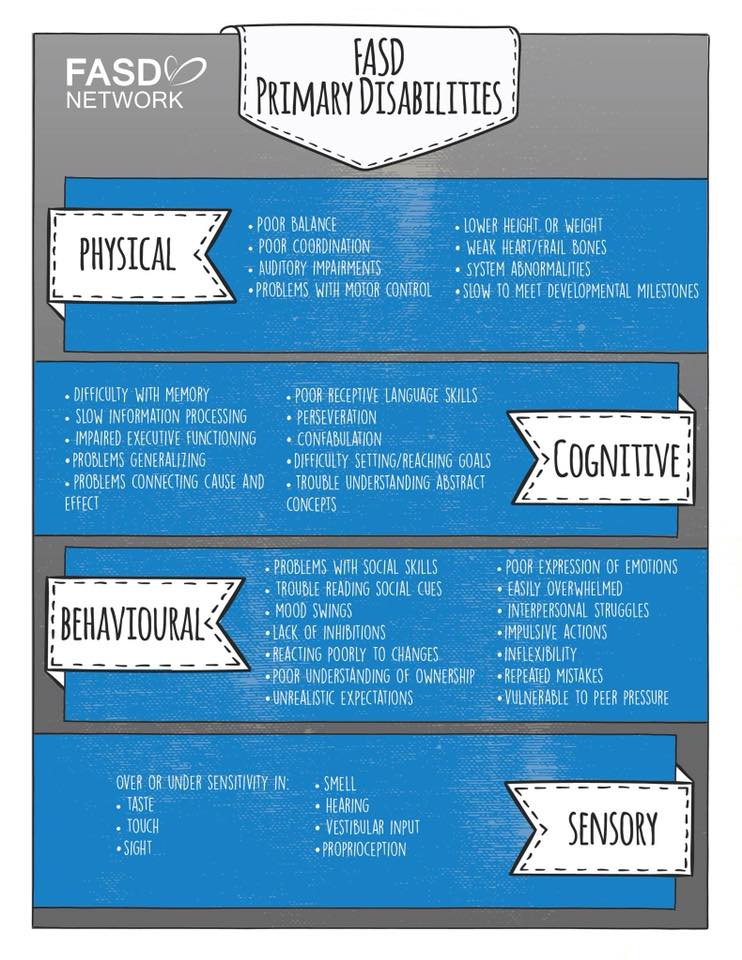
Fetal Alcohol Spectrum Disorders (FASD) is an umbrella term describing the range of effects that can occur in an individual who is prenatally exposed to alcohol. These effects may include physical, mental, behavioral, and/or learning disabilities with possible lifelong implications. The term FASD is not intended for use as a clinical diagnosis.


Diagnoses under the FASD umbrella include:

  • Fetal Alcohol Syndrome (FAS)
  • Partial Fetal Alcohol Syndrome (pFAS)
  • Alcohol-Related Neurodevelopmental Disorder (ARND)
  • Alcohol-Related Birth Defects (ARBD)
  • Neurobehavioral Disorder Associated with Prenatal Alcohol Exposure (ND-PAE)Source: National Organization on Fetal Alcohol Syndrome FASD Terminology Summit, 2004 

Medical issues you might see in a person with FASD:

  • Eye/vision and ear/hearing involvement
  • Palatal concerns
  • Growth concerns
  • Immune system concerns
  • Spinal concerns
  • Cardiac/renal abnormalities
  • Sleep problems

Common misconceptions that many people believe about FASD.

  • The child will show physical features linked to FASD (specific damage depends on what part of the brain is developing when the pregnant mother is drinking)
  • FASD means the child is mentally retarded.
  • Behavioral problems associated with FASD are all due to poor parenting and a bad living environment.
  • Children will just “grow out of it”
  • Mothers had an easy choice not to drink during pregnancy and were just careless. Source: Emory University, Georgia Department of Behavioral Health and Developmental Disabilities (2011)

"Alcohol crosses the placenta. the fetus does not have the ability to metabolize it. It 'pickles' the brain and it causes brain damage. Even with all the drugs that our birth mother did, it was the alcohol that left the legacy that Ellie has."
Saving Ellie: Adoptive Parents Give Up Ill Daughter with FASD

Fetal Alcohol Syndrome (FAS)

Defined and named in 1973, Fetal Alcohol Syndrome (FAS) is a disorder resulting from prenatal exposure to alcohol. Confirmed maternal use of alcohol might or might not be documented.

The diagnosis of FAS follows a specific outline. Individuals with FAS are generally found to have:


  1. Growth problems (e.g. unusually low birth weight and size, before and after birth)
  2.  Facial dysmorphia (e.g. small head, small eyes, underdevelopment of the upper lip, indistinct groove between lip and nose, flattened cheekbones)
  3. CNS abnormality (e.g. delayed brain development, intellectual impairment)

It is important to note that these criteria are for FAS and not Fetal Alcohol Spectrum Disorders (FASD). FASD is an umbrella term that refers to the range of effects, including FAS, that can result from prenatal alcohol exposure. FASD is not a diagnostic term.

Sources: CDC’s Fetal Alcohol Syndrome: Guidelines for Referral and Diagnosis (2004)
“Fetal Alcohol Spectrum Disorders: From Research to Policy” Alcohol Research and Health (2010)


Individuals exposed to alcohol prenatally who do not have identifiable deficits in all three domains required for an FAS diagnosis might be diagnosed with one of the other conditions under the Fetal Alcohol Spectrum Disorders continuum, such as Partial Fetal Alcohol Syndrome, Alcohol Related Neurodevelopmental Disorder or Neurobehavioral Disorder Associated with Prenatal Alcohol Exposure. Source: FASD Competency-Based Curriculum Development Guide (2008)


Alcohol-Related Neurodevelopmental Disorder (ARND)

ARND is a condition under the Fetal Alcohol Spectrum Disorders (FASD) umbrella. ARND refers to a complex range of disabilities in neurodevelopment and behavior, adaptive skills, and self-regulation in the presence of confirmed prenatal alcohol exposure. 

Specifically, individuals with ARND do not have the FAS facial abnormalities but may have developmental disabilities including structural and/or functional central nervous system dysfunction (brain damage) with behavioral and learning problems. Source: Recognizing ARND in Primary Health Care of Children Consensus Statement, Interagency Coordinating Committee on FASD, 2011


Paternal Contributions to Alcohol-Related Birth Defects (ARBD)

Can developmental abnormalities be predetermined at fertilization? Research proves so. 

The authors of this study believe alcohol consumption by the father affects genes in sperm which are responsible for normal fetal development.
Until now fathers' lifestyle choices have not seen any repercussion on their unborn children. This ground-breaking research provides the first definitive evidence that fathers' drinking habits pre-conception can cause significant fetal abnormalities.
Taylor & Francis. "Fathers drinking: Also responsible for fetal disorders?." ScienceDaily. ScienceDaily, 14 February 2014. <www.sciencedaily.com/releases/2014/02/140214075405.htm>.

A study at Georgetown University Medical Centre claims a father’s alcohol intake, age, diet, and psychological state could all make a difference. Joanna Kitlinska [an Assistant Professor at the Department of Biochemistry and Molecular & Cellular Biology at Georgetown] claimed that up to 75% of children with FASD have biological fathers who are alcoholics.
https://geneticliteracyproject.org/2017/09/13/alcohol-consumption-fathers-lead-fetal-alcohol-syndrome/


Mayo Clinic's Recommended Treatment for Behavioral Problems)
As a parent of a child with fetal alcohol syndrome, you may find the following suggestions helpful in dealing with behavioral problems associated with the syndrome. Learning these skills (sometimes called parent training) can include:
  • Recognizing your child's strengths and limitations
  • Implementing daily routines
  • Creating and enforcing simple rules and limits
  • Keeping things simple by using concrete, specific language
  • Using repetition to reinforce learning
  • Pointing out and using rewards to reinforce acceptable behavior
  • Teaching skills for daily living and social interactions
  • Guarding against your child being taken advantage of by others because many children with fetal alcohol syndrome are at risk of this
  • Early intervention and a stable, nurturing home are important factors in protecting children with fetal alcohol syndrome from some of the secondary disabilities they're at risk of later in life.


Discipline Problems vs Behavior Problems


Discipline problems (noncompliance, misbehavior) occur when the caregivers have not structured the child's environment for success, or when parents are inconsistent (expectations or consequences), non-responsive, or inaccessible. When adults adjust their behaviors and attitudes, often children with discipline problems can be brought under control in as few as 3 to 7 days. This is the premise behind the show World's Strictest Parents.


Behavior problems, on the other hand, lie within the child. These are persistent behaviors that do not disappear even with the best parenting (although good parenting can help to control the behaviors). These can include impulsivity, inattentiveness, and other behaviors like ADHD, FAD and immature behaviors associated with missing capacities in object relations.


YOU CANNOT EXPECT PUNISHMENT OR DISCIPLINE TO "FIX" BEHAVIOR PROBLEMS!


Having behavior problems is like being born with poor eyesight. No amount of punishing or controlling is going to fix this problem. Glasses might help. However, the parent will be responsible for taking the child for regular eye check-ups, teaching him how to care for his glasses, and restricting activities where glasses might break. The goal is that by the time the child is 18, he will be ready and able to take full responsibility for the care of his own eyes and glasses.


How Do You Tell the Difference?

So how do you know if your child has a discipline problem or a behavior problem? The best way is to change the home environment. If the behavior stops or improves it is most likely a discipline problem. If it remains unchanged but more in control, and the parent is acting consistently, it is likely a behavior problem.

from Therapeutic Parenting: Chapter 2 Discipline vs Behavior Problems


HOW WE HANDLED IT:


I'm not actually sure if my children have an FASD. I do know that they both have permanent brain damage and the resulting behaviors and issues are similar if not the same. 


We did 3  things:

  1. Changed Our Expectations. 

    Really changed them. Redefined success for my children.  We lowered our expectations to what they could actually handle, not what their neurotypical peers could do or what their teachers and other professionals thought they "should" be able to do.. See this Level Chart post for some examples. 

    Changing my expectations also helped ME immensely (Finding the Joy).  I'm less frustrated by their inability to do things that would be "normal" for a teen.  I do have to constantly remind myself "She's only 6!  She's only 6!  She's only 6!"
  2. Parented with LOTS of Structure and Caring Support.

    It took me a long time to believe it, but my children actually 
    craved caring structure. 

    When I began providing Caring Structure, I thought for sure they would rebel and make our lives miserable. They didn't always like it, but it seemed like their few complaints were based on what their peers thought about it, rather than something they were truly feeling. Unlike my neurotypical, biochildren who understandably would have protested the strict structure their adopted siblings required, most of the time, my adopted children just accepted it and moved on.


    Without this structure or when we "lightened up," my son would act out until he had to be returned to the stricter structure level. Somewhere deep down, subconsciously, his brain knew he needed that structure to feel Safe.

    My kids were easily overwhelmed and had a small window of tolerance. They were easily frustrated and were often dysregulated. We had to simplify their lives a LOT to
     lessen the feeling of “overwhelm.”  
    We did this by making their world smaller. 
    This was often like childproofing – avoiding and removing things and events that can be triggers.

    See this post for how we did this - Structure and Caring SupportAnd this post for dealing with Dysregulation and Meltdowns.
  3.  Switched to Therapeutic Parenting
    Found my children's developmental/ emotional age and began therapeutically parenting them based on that age - Therapeutic Parenting Based on Emotional Developmental Age.


Guest blog: Our Story
We adopted T. at age two from a Russian orphanage. Minimal information was given on her life before age two.  There was a cute video of her interacting with a caregiver, and that was it, we loved her!  We knew that she had some kind of sad past, probable neglect, and we were willing to do "attachment therapy", or whatever it would take to overcome her delays.  We, meaning my husband and I, already had a bio daughter who was eight at the time and lovely, so we thought of ourselves as great and experienced parents.  
T. was evaluated in Russia as having normal intelligence and "usual orphanage delays" so we were confident we could help her overcome her past.  
From the beginning there were difficulties but we were ready!  So we thought.  T. could barely walk, very unsteady on her feet yet she would NOT hold our hand, she would rather fall it seemed.  We had to force our hand holding for safely.  Trying to bond was difficult, I would rock her with a bottle, trying to make eye contact, as was recommended by the social worker.  
In retrospect, I think we overwhelmed her with attention, sensory overload, etc.....It was a hate/love relationship from the beginning, she would push me away, but then if I left, she would cry for me.  All very confusing, and we were in constant contact with the social worker.  The social worker said it would take approximately two years for us to become a "family", to make up for the two years she had no one.
So, we waited patiently until she was four.  T. seemed quite smart, could dress herself, learned to read even. But stubborn!!!!!  Loving arguments, wanting her own way ALL THE TIME.  We fought her, becoming more strict, determined not to let her be the boss of us, which seemed her constant goal.
School was a nightmare, she hated it, hated the other kids, hated being told what to do...
Many doctor appointments were going on through these early years since T. had Tuberculosis and other infectious things happening.  At every appointment I would mention her behaviour but it was never too bad at the doctor appointments, she did her charm routines and fooled everyone.  She was learning ok at school and labelled as "a bit hyper".  
The summer after grade two was a game changer.  I was determined to do a little school work each day with T., and this is when I realized she could not remember much of what she'd done in grade two.  Red flags were popping up more and more, regarding her learning and behaviour.  On the internet, we found an adoption clinic near us and made an appointment.  
It was there that Tanya was diagnosed with Alcohol Related Neurological Disorder at age 8, based on her smaller head circumference, and behaviour issues.  The 4-digit diagnostic code was used for FASD diagnosis, photos and measurements were done.  Attachment disorder was also diagnosed.
That same summer I had stumbled upon the book "Damaged Angels" by Bonnie Buxton, which is the true story of Bonnie finding out about her daughter's FASD.  So we were somewhat ready for the diagnosis. It gave an explanation for what was going on.
We were able to get T. into a multiple exceptionality class at school, after her diagnosis and some psycho-educational testing. Fast forward to the present.  With all the help and encouragement T. has received over the years, she has still not been successful in getting her highschool diploma, or a job.
We did keep a binder of all medical and school reports through the years so she has been able to qualify for the Ontario Disability Support Program. [How Do You Keep Your School Stuff Organized?]
What will the future hold, so unknown? 
T. wants all the things she sees her older sister having, a boyfriend, friends, a job, etc.  But she's very unrealistic about her goals, doesn't take the first step to make a goal happen, wants to be "in charge" of people for a job but refuses to wipe tables, or take any kind of beginner job. She refuses to take advice from people who are smarter than she is, very frustrating.
We manage her day to day, letting a lot of our rules go by the wayside for the sake of peace and harmony in our home.  For example, she eats whatever, whenever, and not usually with us. We "bond" by watching a tv show together, her request.  She wants to "bond" on her terms but I have to get my way too.  Our bonding tv time is between 9-10 am so she will be UP out of bed.  Some kind of routine is necessary so she will be awake during the day, sleeping at night.  At least.
We do try to say YES as much as possible, but will get her to do a chore BEFORE the yes, because promised chore will never happen if she gets the YES first.  Such is the way of her attachment difficulties, she does not help me out of LOVE but only to get a YES about something she wants.  
I refuse to argue with her and I have changed my mindset to not stress about things.  
Somehow, through the years, acceptance has settled in and a realization that no matter WHAT we do, the FASD and attachment issues will NEVER go away.  LIfe goes on.

Thursday, September 28, 2017

Clutter, Hoarding, and Cleaning Their Room

Excerpts from The Psychology Behind Hoarding When does cluttered turn to hoarding?Posted Sep 05, 2014 Gregory L. Jantz, PhD 
Hoarding is considered an offshoot of Obsessive Compulsive Disorder (OCD), but recently this categorization is being reevaluated. It’s estimated that about one in four people with OCD also are compulsive hoarders. 
Without exception, hoarding is always accompanied by varying levels of anxiety and sometime develops alongside other mental illnesses such as dementia and schizophrenia.
Recent neuroimaging reveals peculiar commonalities among hoarders including severe emotional attachment to inanimate objects and extreme anxiety when making decisions.
Hoarding both relieves anxiety and produces it. The more hoarders accumulate, the more insulated they feel from the world and its dangers. Of course, the more they accumulate, the more isolated they become from the world, including family and friends. Even the thought of discarding or cleaning out hoarded items produces extreme feelings of panic and discomfort.

Symptoms of hoarding (Mayo Clinic):

  • Cluttered living spaces
  • Inability to discard items
  • Keeping stacks of newspapers, magazines, or junk mail
  • Moving items from one pile to another without discarding anything
  • Acquiring unneeded or seemingly useless items, including trash
  • Difficulty managing daily activities, procrastinating and trouble making decisions
  • Difficulty organizing items
  • Perfectionism
  • Excessive attachment to possessions and discomfort letting others touch or borrow possessions
  • Limited or no social interactions

Commonalities among hoarders (Mayo Clinic). 

  • Age: While severe hoarding is most common in middle-aged adults around the age of 50, their hoarding tendencies began around ages 11 to 15. During these early teenage years, they typically saved broken toys, outdated school papers, and pencil nubs.
  • Personality: Oftentimes hoarders struggle with severe indecisiveness and anxiety.
  • Genetics: Although hoarding is not an entirely genetic disorder, there is some genetic predisposition involved in the disorder.
  • Trauma: Many hoarders experienced a stressful or traumatic event that propels them to hoard has a coping mechanism.
  • Social Isolation: Hoarders are often socially withdrawn and isolated, causing them to hoard as a way to find comfort.

Why Children with Attachment Issues Are More Likely to Have Issues with Clutter, Hoarding, Chores, and Cleaning Their Room


Chaos feels normal

A child who grew up in chaos might act in ways to trigger that chaos, because that is the "norm" for their neurological system. Even a child who came straight from the hospital to your home, still might have been "pickled" in stress hormones in the womb. To them, chaos feels "normal," and they will act in ways to make their life feel normal and Safe (this is a "perceived safety" and has nothing to do with their current situation - where of course they are safe. Why Doesn't My Child Feel Safe?)

How we handled it:

Children NEED Structure and Caring Support to feel safe and start to heal. This feeling of safety is not about physical safety and rarely based in reality – it is a perceived feeling of safety. It feels life or death to them! To help them feel safe, we increased the level of structure we provided.

By helping them get and stay regulated, we saw fewer meltdowns and other dysregulated behaviors (like hoarding and being unable to keep their room clean). The more structure and regulation we provided, the more it felt normal to them. Chaos finally started losing its appeal. 


Executive Functioning - ex. Attention Deficit Disorder (ADD/ADHD), PTSD, and damage to the frontal lobe
It's common for kids with attachment disorders to have issues with executive functioning. 
Executive functions are a set of processes that all have to do with managing oneself and one's resources in order to achieve a goal.


  1. Working Memory - Being able to hold something in mind and then use it (like a list of tasks/ chores or how you told them to do something).
  2. Cognitive Flexibility - the ability to think about things in more than one way to solve a problem.
  3. Inhibitory Control (self-control) - being able to regulate emotions, ignore distractions, and keep from acting impulsively.
Sound familiar? All of course are required to be able to do chores and clean their room! See the post Chores, Responsibilities, and Other Things my Children Can't Handle.

How we handled it:

 This depended on what was causing the issues. For the ADD/ADHD - we mostly chose the medication route, but this post has some additional ideas. For the PTSD and other trauma issues, it took time and therapy. This post has some additional ideas. Unfortunately, for the brain injuries, like damage to the frontal lobe, we were able to help the children learn some "work around" techniques. This post has some additional ideas.

Too Many Steps 

An overwhelmed child will often freeze or even regress to more child-like behaviors. Kitty was not able to do things independently, like clean her room. Especially in the early days of her time with us. 

How we handled it. 

First, I cut back on the chore expectations. I changed what I thought she "should" be able to handle, to more (emotional) age-appropriate tasks. 

I would break down tasks into small steps and give them to her one at a time. Instead of saying, "Clean your room," which was overwhelming and just didn't happen. I would say, "Empty your trashcan." and when that was done, then I would say, "Put your dirty clothes in your laundry basket." When that was done, I would say, "Put your laundry basket next to the washing machine." Most of the time, I would have to do these things with her (not for her, but be present in the room, often helping clean near her). Chores, Responsibilities, and Other Things My Kids Can't Handle.


Eventually, she got to where she could do a few tasks at a time, but the chaos in her head will always be reflected in the chaos of her room. I still help her keep it regulated. Therapeutically Parenting the Adult Child


Why Do They Do That?

Sexual Abuse

A sexually abused child may try to make him/herself "unattractive" by being "dirty" or smelly. This can include his or her room.

How we handled it:

Chapter 6: Abuse
A related post about why my child's room (and person) reeked and how we handled it - The RAD Stink.


Addictive Personality

The Addictive Brain
Finally an article that puts in to better words why my son has an "addictive brain." We've seen evidence of it for years, and knew it wasn't the drugs themselves, because the addiction shifted often and he could stop seemingly cold turkey (drugs, alcohol, tobacco, but also sugar/ junk food, sex, stealing, adrenaline, chaos...).

"Professor Peter Cohen argues that human beings have a deep need to bond and form connections. It's how we get our satisfaction. If we can't connect with each other, we will connect with anything we can find -- the whirr of a roulette wheel or the prick of a syringe. He says we should stop talking about 'addiction' altogether, and instead call it 'bonding.' A heroin addict has bonded with heroin because she couldn't bond as fully with anything else."


So my son remains "addicted." In part because his attachment issues - the (in)ability to make human connections - haven't really healed, but also because his Chronic Post Traumatic Stress Disorder means he is stuck living in a "war zone" 24/7. He carries his old "cage" with him wherever he goes.


How we handled it: 

The Addictive Brain


Food Hoarding
This post has more information about why kids hoard food, which has some commonalities/ similarities to why they hoard trash and clutter.

How we handled it: 

Food/ Hoarding/ Diet


Hypervigilance/ Living in a Warzone

Kids of trauma are often easily triggered, extremely sensitive to emotions, unable to regulate their emotions... causing them to react as if they are in a warzone.  You can't learn and attach if you don't feel safe and you're living in a war zone!  Hypervigilance (obsessively monitoring their environment) is super common among kids with PTSD.  It relaxes when they start to feel safe, but probably doesn’t ever really go away.

How we handled it: 

Why Doesn't My Child Feel Safe?


Poop and Other Bodily Fluids

 It's part of them. Some children develop an irrational fear of the potty or "losing" part of their body (poop).  I have seen a child "hold it" all day to avoid having to use the restroom at daycare, waiting instead until she was put in a diaper at night - causing serious intestinal issues. 

I've heard of kids hoarding/ hiding jars of pee, dirty pull-ups, used kotex... I can only assume at least part of this is related to whatever causes them to hoard. 


How we handled it: 

Potty Issues - What's That Smell?


Low Tolerance/ Overwhelm
Our kids tend to have a low tolerance for stress and are easily overwhelmed. 

How we handled it: 


Simplify

It is sometimes necessary to simplify a child’s life a LOT to lessen the feeling of “overwhelm.”  This can be like childproofing – avoiding and removing things and events that can be triggers.

Make Their World Smaller

This can be making their world smaller and lowering expectations. Level Chart post.

Strip The Room

Following a therapist's advice, we stripped the child’s room to only a bed, one or two stuffed animals, a book, and not much else. In times of extreme stress, we moved our child's dresser to our room. The child had to bring dirty clothes to “check out” clean ones.  This helped with hygiene issues, and lessened the amount of overwhelm. It made cleaning the room easier for the child to do him/herself (if they were able to do it alone at all). 

Room and Belongings Searches 

Bear frequently stole things and hoarded food and other items. Usually when searching his room, I gave it a good cleaning and removed all contraband and health hazards. While I usually did this randomly when he wasn't at home, Bear was aware that we did this for his safety, and rarely protested - even when I found contraband and gave him consequences.

Age Appropriate Expectations - 

Expectations are reduced to the child's emotional age. Kitty may be 16, but when dysregulated, emotionally she'd drop to about 6yo. Her daily chores became super basic.
We had a long discussion with Kitty about being emotionally 6 (still ticks her off to hear that), and that it wasn't fair to expect her to be able to handle certain things, and we felt it was cruel to dangle higher level privileges she couldn't actually achieve over her head. So therefore, I was going to stop "punishing" her for not being able to do things she wasn't ready for yet. Age Appropriate Expectations 

Chores-

We gave Kitty fewer chores and they are very simple and concrete. They were chores that would normally be given to a younger child (her emotional age). She did the same chores every day instead of rotating like the other kids. Chores

Put It in Writing

Lists cut down on the arguing. It always surprises me how much less the pushback is when I say, "Is your list done?" instead of, "Do {this} now." I think it's because there is less implied "criticism" from a list. Criticism is probably one of Kitty's biggest triggers, even if there was no criticism happening. It's not a reality based thing, it just feels like it to her.

Changing Your Expectations

Changing my expectations has helped ME immensely (Finding the Joy).  I'm less frustrated by her inability to do things that would be "normal" for a teen.  I do have to constantly remind myself "She's only 6!  She's only 6!  She's only 6!"

Declutter

At home, I did things like declutter and clean the child's room myself (Decluttering), because even with me helping them clean, it was overwhelming. So I did it when they weren't there, although I let them know ahead of time.  I left nothing but a bed, a book/ quiet toy, and a stuffed animal, at one point I even had my daughter's dresser in my room, and she "checked out" her clothing by bringing me the dirty ones, THIS WAS NOT A PUNISHMENT. I tried to find ways to help them understand that. I pointed out that now cleaning their room would be a lot easier! (Explaining Age-Appropriate Parenting to Your Child)


DE-CLUTTERING IDEAS:

Decluttering Post

Kid school projects

For all the cute school stuff the kids brought home, I'd put it in a folder marked with their name and age/school grade. A couple of years later, surrounded by the detritus of 2-4 kids' massive amounts of awards, report cards, stories, art projects I am able to go through it again and be fairly vicious. You can also take a picture of the item and trash the original.

Moving Time

Every time we move stuff around (like when I had to give up my sewing room to Bob for a bedroom), I try to go through it again with an eye to "what have I used recently... or never"?

Santa is Coming

Twice annually, I try to have the kids go through the house and de-clutter their own stuff. It works especially well to do it over the Thanksgiving holiday. I think I've blogged about this before. Basically I tell the children that Christmas is coming and they have too much stuff. Lots of kids would love the stuff that they no longer play with and the more they give away the more room they'll have for new toys from Santa!

Numbers Game

When going through items they had many of, I told them they could keep "X" number of items. I tried to make it sound like I hadn't just pulled the number out of the air. Sometimes it was based on their age, how many they needed (7 days in a week so 10 shirts), or how much room the toy took up (Ex. Ponito got to keep more match box cars than his age that year, but Bob could only have 10 stuffed animals). I didn't tell them my reasoning, just said, "You can keep 10 stuffed animals." This way the control issues were kept to a minimum and they didn't argue with me about what should be kept (it wasn't my decision it was theirs!). Helped them learn to prioritize what they like and wanted.

Fashion Show

I don't know how the clothes manage to accumulate like bunnies (except for socks of course, which disappear singly). Rather than just having them try on clothes, we make it a little more fun with a "fashion show." Once we have clothes pared down to just what fits, then they have to pair it down to just what's needed (the rest can go in the Clothes Closet or Good Will bag), usually one for every day of the week, plus a couple of extras. They get to choose which clothes they want to keep.

Clothes Closet

Clothes are back to being a huge issue for me because the girls and I wear similar sizes and all of us fluctuate in weight so it's harder for me to get rid of the clothes (I want to hang on to them just in case). I tend toward classics so it's not as easy as throwing away all the acid wash jeans with zippers and the ripped up sweatshirts (am I showing my age)?

Garage Sale Prices

I paid the kids $1 a bag (large kitchen trash bags) for all the toys they got rid of - the theory was I would sell them at some future date in a garage sale and this way they got their share of the money now instead of waiting and hoping it would sell. We got rid of a lot of those McD*nald type toys that clutter up everyone's toy boxes! I also paid them $1 for full bags of trash (to try to avoid the kids putting trash in the sale bags to fill them up faster).

Sort Immediately

Laundry is my nemesis. I try to put the laundry basket near the drawers or closet where the majority of them go and put them away directly into the appropriate drawer, but I have to admit, we have a couch in our bedroom that is draped with sorted piles of clean clothes (my husband's shirt stack, my shirt stack, his undies, my undies, matched socks, folded towels...). Not sure why I have trouble doing that extra step of actually putting them away.

Paperwork is my other big clutter issue. Hubby keeps every bill we ever had - mostly not opened because he pays online - and that's a LOT! I have IEPs, psych evals, applications, reports... for both kids. I've gotten a little more organized about that, because otherwise the piles will eat me (I love my 3" 3-ring binders). Now that I'm in two NAMI classes, trying to study for my social work license, and keep up on my reading, that adds up too. I try not to even go to the mailbox unless I'm ready to sort right then. Hubby's, Old Company, Mine, and Trash (recycling). Coupons and stuff go in my car - which I usually end up throwing away as they expire.


Inspiration

I read books about de-cluttering, watch lots of trash TV including things like Clean House and other decorating shows for inspiration. I signed up for Fly Lady at one point - which was really helpful. Of course the kids are old enough now to do lots of stuff for themselves (laundry, dishes, etc.) as evidenced by our chore chart.

More posts on techniques for stripping/ decluttering the room:

Adult Boarder vs "Family Girl"
Therapeutically Parenting the Adult Child

How To Strip a Room:


When Bear finally officially moved out. His room was way worse than this. And it wasn't the first time I had to do this. {Post: Ewww!!!}

Here's what I did: 
1. Wore gloves. My daughter, Bob, was helping me one time and picked up a used condom with her bare hands. She never helped me again, and I started wearing gloves!

2. Gathered up Containers and Supplies - 
  • Gloves!
  • Box of white kitchen trash bags
  • Black sharpie to label bags. 
  • Tied a trash bag to my belt loop. 
  • Labeled a bag for Donate (I used white kitchen trash bags for these so I could write "Donate" on the bag and it wouldn't get mixed with trash).
  • Box for things that belonged elsewhere in the house. 
  • Bag for dishes and cups. 
  • Several laundry baskets. 
  • One Rubbermaid Tub for things he might want to keep (high school diploma, pictures of his birth family, school yearbook, winter coat...)
  • Cleaning supplies - for later, I emptied the room first.
3. Started at the Doorway and worked my way in to the room. Once the floor was clean enough to stand in the room, I'd pick something to start with (a dresser, a book shelf, the bed...). Once it was stripped, then I'd move to the next area.

4. Threw it in the Hall. When a bag, box, or basket got full, I'd throw them out into the hall. 

5. Take it Where It's Supposed to Go. Whenever the hall got full, I'd take out the trash, line up the Donate bags by the front door to be loaded in to my car, drag the laundry baskets to the laundry room and dump them on the floor so I could take the baskets back upstairs (and start or switch over a load). Dump the dishes in the sink. Then I'd start again until the next time the hallway got too full.

On one of these cleanings, I pulled out 20 loads of laundry (clothes, towels, bedding, About 9 bags of trash. 1-2 bags of donate (most stuff was too trashed to donate). 1 large Rubbermaid tub of things he might want to keep. Only one bag of dishes! And a relatively small pile of things that weren't his (it hadn't been that long since I last searched his room for contraband). 

6. Sort. When the laundry was clean, I had 3 kitchen trash bags of clothes labeled by size (his weight fluctuated - Med, Large, XL). I dispersed the remaining laundry and the box of stuff that wasn't supposed to be in his room (kitchen towels, bathroom towels that weren't his, stuff he'd stolen...) where they was supposed to go. Stuff stolen from non-family members went to the school so they could figure out who it belonged to. 

7. Clean! Start at the top (ceiling fan) and work your way down. I used a lot of 409 type cleaners.

Those big white patches on the wall are where he punched his fist through the wall.
8. Repair. Patch holes in the walls (he often punched his fist through the walls), replace furniture and repair things like the ceiling fan and window curtains, repaint, and throw away carpet (as needed). 

We had to throw away the carpet, because we discovered he was spitting in the house. The walls also had to be sanded down and repainted for the same reason.