Bear is starting with a new therapist who wants to start working with his PTSD. Bear doesn't know what PTSD is (or attachment or trauma or values!) so the therapist recommended we all read something on it so we could all get on the same page. The problem was I couldn't find something written for kids - especially at Bear's reading level (about 5th grade). So I adapted this one from Attachment Trauma Network (http://www.radzebra.org/WhatIsPTSD.htm)
What is Post-Traumatic Stress Disorder and Complex Post-Traumatic Stress Disorder?
Many adopted children are diagnosed with Post-Traumatic Stress Disorder, or PTSD. A child might get PTSD if something happens to them that causes them great pain (emotional or physical). This trauma might include adults not always taking care of the child’s basic needs (food, changing diapers, hugs and attention...), an adult hurting the child, the child being taken from his or her family (even if the child was not safe that child will still miss them), the child being left with many people, or having to move a lot.
Some of the ways children and teens might act if they have PTSD:
1. Extreme emotional reactions. This is how the child reacts to things - sometimes acting in ways that don’t match what is going on.
2. Angry outbursts. This could be yelling, hitting, crying, cursing…
3. Obsessive repetitive play. Being unable to think about anything else, just doing the same thing over and over. What the child is doing might be like upsetting things that have happened in his or her past.
4. Sleep Disturbances. The child has trouble with how and when he or she sleeps.
5. Unusual or excessive fears. Being afraid of almost everything, or of things that don’t scare most kids.
Other children might have Complex Post Traumatic Stress Disorder, or C-PTSD. Children with C-PTSD had trauma in their lives regularly and without anyone taking care of them all of the time.
Some of the ways children and teens might act if they have C-PTSD:
1 Attachment – Many traumatized children do not accept discipline, get in other people’s personal space, distrust others, and lack friends.
2 Biology – Many traumatized children stiffen when touched, do not feel pain, exaggerate small pains, and take longer than others to learn how to ride a bike, skate or perform other movements requiring both sides of the body working well together. Often the chemicals in the body do not work like they should, including hormones - which can make a teen cranky, angry, and maybe violent. There might also be sleep problems, early puberty, depression, and other problems. Many children also have ongoing stomach issues (like gas or diarrhea).
3 Affect or emotional regulation – Many children show strong emotions all the time and have a hard time calming down. They might easily explode into a violent rage over the smallest things (for example, the word “no” or even, “Let’s talk about this later.”; cry for an hour over a trivial remark; worry for days about an imagined insult. Many children can’t tell others what they feel; when asked what they feel, they say they “don’t know.” Some children are “too good,” pretending they are always happy. Some children don’t seem to understand most of their feelings, except anger. These children often feel depressed, numb and/or think about suicide all the time.
4 Dissociation –Many children repeatedly dissociate (disconnect, day dream or distract themself) when confronted with trauma triggers (things that make them think about awful things from the past), such as an adult’s angry voice or facial expression, a parent leaving the child with a sitter or at daycare, the sight (or even the thought) of babies, or diapers, or dolls, or a child car seat belt. Dissociation may not always be obvious to someone who is not trained to see it. Some children use television viewing or sleeping as a way of dissociating. When dissociated the child may not remember what happened or not think about it having happened to them.
5 Behavioral control – Many children fire before they aim - they do things before they think about how their actions might affect others or even themselves. They interrupt, butt into line, grab, push, or say the first thing that pops into their heads. Some children self-harm in large or small ways (cutting, hitting) or engage in destructive attempts to self-soothe (calm themselves), such as picking skin, rocking, head banging, chewing on their lips, masturbating. Many children are aggressive, particularly with parents but not only with parents. They hit, pinch, kick, bite, and throw large objects. Many children suffer from nightmares, night terrors, bruxism (tooth grinding), restless leg, and night waking. Some children turn to drugs and alcohol. Some children suffer from eating disorders even as infants and toddlers; many more develop eating disorders as they mature. Older children are prone to drug and alcohol abuse. Many children refuse to do as they are asked to do. Others show a false front and deny their own wishes and feelings in an effort not to rock the boat. Finally, many children live out the type of trauma they have suffered, either in their play, or simply in their day-to-day contacts with others.
6 Cognition – Many children cannot focus or pay attention when they are supposed to pay attention and they cannot plan tasks well or get organized. Some children seem dulled-down and are not curious about their world. Many children do not totally understand the idea of “object permanence.” If they can’t see someone, they don’t know or believe on a deep level that she is still there (obviously this can effect attaching to or caring for another person, like an adoptive parent.) Many children don’t understand the idea of cause and effect, especially involving his or herself; they do not grasp that if they hit someone, that person will not want to be their friend. Many children suffer from learning disabilities. Many children show delayed development of language skills. Many children can’t handle bright light or medium-loud noise (yet scream themselves). They may find it terrifying (or unusually thrilling) to spin, swing, or hang upside down. Many children struggle to complete puzzles or read maps or learn how to tell time.
7 Self-concept –Many children doubt their own reality; they chatter nonsense constantly partly as a way of helping themselves believe that they exist. Many children believe they are bad, unworthy, wrong, or at fault for every negative thing that has ever happened to them. Some children imagine they are fat when they are not, or believe they are much smaller or less powerful than they are. Many children cannot see where they leave off and others begin, and as a result, they constantly invade others’ personal space, either literally (waving a book two centimeters from someone else’s nose, clinging to a parent at an inappropriate or even dangerous moment, such as when the parent is standing at the stove) or metaphorically, with constant demands for attention. Some children can’t believe they could ever do anything to feel better about themselves, and some children fear that they are “damaged goods,” “trash,” “garbage,” or “unfixable” and that if they show their bad sides, their adoptive parents may send them back to the orphanage or to another foster home.
Adapted and abridged from Attachment and Trauma Network
http://www.radzebra.org/WhatIsPTSD.htm

Showing posts with label PTSD. Show all posts
Showing posts with label PTSD. Show all posts
Saturday, September 5, 2009

Monday, March 9, 2009
PTSD Update: Saturday Evening
Fireworks!
So Kitty excitedly showed Dad her new shoes. Hubby, knowing the story behind the shoes asked to see Kitty's old shoes (the ones that were "ruined.") Kitty showed the minuscule separation of the sole from the shoe that was so big she could "fit her finger in it!" Let's just say the shoes were not ruined, and when Hubby mentioned this, the meltdown started.
Long story short - shoes are apparently more important than anything. Hubby told her she would not be allowed to keep the new shoes because she lied about her old shoes. She started screaming, cursing, and continued to escalate until she eventually had to be restrained. *sigh*
The grandparents came and picked up the other children to take them to spend the night. The kids were happy to get two pieces of candy before they left -one for tolerating all the hassle Kitty had caused in the car and one for the evening's continuing episode.
Friday evening at Kitty's therapy session that Hubby and I go to now without her, the EMDR therapist brought up residential treatment (RT) for Kitty. I know it benefited Bear so much, but I still feel that the only reason it helped him was because he finally got a correct diagnosis and medications. The therapy seemed useless. He had never bonded to us, but was impressed by the fact that we visited all the time and had never given up on us. Whereas Kitty is anxiously attached to us, and I'm pretty sure of the accuracy of her diagnoses and medications.
I feel that Kitty's biggest issues right now are with her diagnoses that are least effected by medication - Complex PTSD and Attachment Disorder. RT just doesn't seem right for Kitty, but Hubby and the therapist are right too, she is getting steadily worse and it is effecting the quality of life of the whole family.
Hubby dealt with the brunt of Kitty's rage on Saturday night. He talked to her calmly and was firm, but actually got her to calm down instead of escalating. After an hour and a half of meltdown, Kitty made a comment about not deserving a family. Hubby questioned her on this, and didn't allow her to change the subject or deny she'd said it (not an easy task!). I did clarify that she knew what deserve meant, and she did. She eventually admitted that she did not "deserve" a family because she is a "horrible child." That a family did not "deserve" to have her inflicted on them. I asked her what made her a horrible child and she said "me, my personality, that's just who I am."
Kitty was obviously exhausted, and we think her true emotions were allowed to slip. She almost instantly began denying she said anything like that.
My poor baby. This made my heart break (and still makes me cry just thinking about it). She believed every word of it too. With the kind of deep down belief that defies logic - like trying to convince an anorexic person that she's not fat.
I think this might be the root of her issues. When we first took Kitty to attachment therapy the AT asked her why she went into foster care. Kitty said it was because she threw a chair. It's very common for kids to believe that this is their fault. The AT and I worked for a long time, trying to convince her that it was Biomom's poor parenting skills and issues (without putting down Biomom), that caused Biomom to feel unable to parent Kitty. I would guess from Kitty's statement Saturday night that although Kitty heard what we said, she didn't internalize it.
Kitty has always been "shut off" in regards to most of her physical and emotional feelings. She is not ticklish, she does not appear to feel physical discomfort. When she is afraid or upset she tends to dissociate. Over the years we have learned how to draw her back when she gets into the "Fight, Flight or Freeze" mode. We have been holding her accountable and not allowing her to "forget" the past or things she doesn't want to deal with.
We started EMDR therapy in July and at first she trotted out all the "mean men" stories that I had heard many times before. Then she refused to talk about her past at all and tried to distract us with rages against Grandma, teachers, siblings and of course Hubby. When I tried to bring up the past again, and was consistent about it, not letting her off the hook. She claimed nothing had ever happened and she "didn't remember" - not even the old standbys she'd told over and over. I think we'd started getting too close. That she was afraid we would discover what a "horrible" child she is.
After about 3 hours of raging, and one hour of talking, Kitty was finally calm and able to go to sleep. It was 11:30pm. So much for Hubby's and my date night. We sent her up to put on her PJs, and Hubby and I processed for a few minutes. Then I went upstairs to tuck her in. She was very cuddly and let me sit next to her and even kiss her hair (small token protest when I went for the cheek as usual, so I kissed the top of her head instead). Kitty reminded me that I had promised to tell her how to have good dreams. So I told her and then tucked her in. I'm sure she was asleep in minutes.
Sunday, March 8, 2009
PTSD update - Friday
Recently we've decided to allow Kitty to stop EMDR therapy, even though she's nowhere near "done." While the EMDR "paddles" helped her stay calmer (versus dissociating and other meltdown behavior - crying, threatening, throwing herself to the floor, raging, complaining...), it was becoming evident that she was not addressing or processing her past anymore. She was using the sessions as an excuse to rage and complain about family members (adopted family), and claiming not to be able to "remember" any abuse or issues that she had discussed in great detail as recently as 6 months ago.
Our EMDR therapist, who is very experienced in working with kids with severe trauma, particularly in a residential treatment (RT) setting, said that when they had a child who refused to participate in group, they would often "forbid" the child to come anymore. Depending on the child, he or she had to sit outside of group, unable to participate or they might let the child just not attend. She said the child would eventually want to come back to therapy and ask for the "privilege."
We are a little sceptical, because while our daughter does have ODD (oppositional defiant disorder), she does not have it to such an extreme that forbidding her to do something will immediately make her demand to be able to do it (unless it involves taking away certain foods she is allergic to or movies she wants to watch - then she craves them desperately). She has been in therapy for probably half her life, and is VERY excited to not be going. (She will still see her attachment therapist every other week).
We have been making her life a little more "uncomfortable" though so she might be motivated to go back to therapy. Little things like, "I know you would like to stay home instead of having to do the grocery shopping with me, but dad is staying home with the other kids, and you have issues with dad and men, and you chose not to work on those issues in therapy, so you will be coming with me."
Because her issues are worsening, we are considering completely shutting down her world and removing as many stressors as possible. Just like when someone is allergic to an unknown food you put them on the elimination diet (- remove all possible allergens and add them back one by one watching carefully for allergic reactions).
These are some of the things we are considering:
No interactions with siblings,
No interactions with Hubby unless it is attachment related,
No being left alone with anyone but me, which means no Grandma's house on weekends (she will have to go to bed early so Hubby and I can still have our alone time),
I will be the one supervising her chores (when they are not done before I get home),
No PG movies or Y7 TV shows,
She can still have her Bratz dolls (bleech!), but no more playing with her sister - it becomes more like play therapy and her sister doesn't need to hear the attitude and behaviors, so she can only play dolls with me - the rest of the time they stay locked in my toy box,
Stripping her room more than it already is,
Go back to issuing one outfit of clothes a day (to reduce the stress of choices, putting away her clothes, and not being able to find socks or other things),
Reduce dramatically the number of chores (and allowance),
No more sitting in the front seat of the car (she tends to yell at Hubby and I),
I will make her school lunches and serve her meals,
4 foot rule applies whenever we leave the house (must stay no more than 4 foot away from me),
No playing with neighbor children or in the front yard without me or Grandma present.
Hubby is afraid that I will essentially become her jailor and the family's quality of life will deteriorate more than it already has. I am not ready to give up on her, and am not really sure what other alternatives we have. I partially approached the subject tonight in a 1 1/2 hour conversation with her Friday night. We ended the conversation with me feeling like she'd really listened (major eye contact!) and some of it might have sunk in. You are cordially invited to watch the fireworks!
Friday, February 13, 2009
Warning: gross analogy!

When we first got Bear and Kitty we were warned that Kitty would be the harder one to get through to. This seemed crazy because Bear was a seething pit of anger, while Kitty seemed fairly compliant.
Their old therapist said that while Kitty kept everything inside, Bear wore his emotions on his sleeve. You knew when he was upset, scared, angry or anxious (because he would be visibly seething or actively erupting – he didn’t really have a broad range of expression). Normally Bear stuffed all his emotions (anger, fear… even happiness) in a locked box deep inside him. This would work for about 3-4 weeks and then the box would get full and have to explode - like a volcano. He would spew lava everywhere, with no ability to be concerned for who got burned (including himself). After an eruption, the box would be open for about 10-15 minutes and you could view his tender emotions. We had many heart to hearts with him sobbing, telling us how afraid he was and how hard it was to trust. He was miserable, and hated being out of control.
When Bear got on the right medications (with the right diagnoses), the volcano inside him disappeared! It’s been a year now, and I’m just now believing that it really is gone. He’s still a mess (with the childhood he had how could he not be?!), but he has control over his emotions. Sometimes I worry that he is still stuffing his emotions in that box, it is just stronger now and can hold more. His therapist thinks that he is just getting more mature and does not need to drag out and process all the bad stuff in his past. I worry that it is festering inside him, but I have no real way to access it and probe to see if it is truly healing.
So here’s the gross analogy. My apologies, but it does seem accurate and I can’t think of a better one.
When we got Bear he was an angry, festering wound – raw, infected and oozing on everything he touched.
Kitty appeared healthier because you couldn’t see her wound. It was scabbed over and covered with numbing, self-protecting bandages, but it was still festering and infected inside of her – contaminating her life and her relationships.
With treatment, using the right medications and therapy, Bear’s wound is slowly healing. It will leave scars, but he finally has a good prognosis.
We have not found the right treatment yet for Kitty. Most of our efforts don’t even come close to penetrating her protective bandages. We are seeing the wound and its effects through cracks and I cringe at the devastation and damage that emerges. I am sooo tempted to allow her to close up and keep everyone at bay as is her preference. I wish I could just deny the bandaged and wounded parts and embrace my child, but it is really all or nothing. She has a thin façade that she presents to the world (and even herself), and it requires all her energy to keep her walls up. Until the defensive walls/ bandages are removed – Kitty can’t feel anything. She can’t love or attach. She can’t process and heal.
I am terrified of the road ahead, but I know God will give me/us the strength to get through this. We deserve a chance.
Marythemom
Mom to biokids Ponito(10!) and his sister Bob(12)
Sibling pair adoptive placement from NE 11/06
Finally finalized on Kitty(13) on 3/08 - 2 weeks before her 13th birthday!
Finalized on her brother Bear 7/08. He turned 15 the next day.
" Life isn't about how to survive the storm, but how to dance in the rain."
Tuesday, February 10, 2009
PTSD/ C-PTSD/ DTD in older child adoption
You may have heard of Post Traumatic Stress Disorder (PTSD). It's usually talked about in association with soldiers, victims of rape or other violent crimes, or natural disasters.
DSM-5 Criteria for PTSD
All of the criteria are required for the diagnosis of PTSD. The following text summarizes the diagnostic criteria:
Criterion A: stressor (one required)
The person was exposed to: death, threatened death, actual or threatened serious injury, or actual or threatened sexual violence, in the following way(s):
Criterion B: intrusion symptoms (one required)
The traumatic event is persistently re-experienced in the following way(s):
Criterion C: avoidance (one required)
Avoidance of trauma-related stimuli after the trauma, in the following way(s):
Criterion D: negative alterations in cognitions and mood (two required)
Negative thoughts or feelings that began or worsened after the trauma, in the following way(s):
Criterion E: alterations in arousal and reactivity
Trauma-related arousal and reactivity that began or worsened after the trauma, in the following way(s):
Criterion F: duration (required)
Symptoms last for more than 1 month.
Criterion G: functional significance (required)
Symptoms create distress or functional impairment (e.g., social, occupational).
Criterion H: exclusion (required)
Symptoms are not due to medication, substance use, or other illness.
Two specifications:
Complex PTSD (C-PTSD)
When the Trauma Doesn't End
First proposed by Judith Herman in her 1992 book, Trauma and Recovery, she suggested people dealing with child physical abuse, intimate partner violence, women trapped in sexual slavery, and other people experiencing long-term stress often showed symptoms very different from people experiencing single-event traumas. As a result, they can often become passive and withdrawn (due to learned helplessness), or develop highly unstable personalities. This could lead to dangerous repetitive behaviours such as becoming involved with violent partners, repeated self-harm attempts, or chronic substance abuse.
Though not part of the new DSM-5, suggested C-PTSD symptoms in adults include:
Developmental Trauma Disorder (DTD)
Since C-PTSD does not adequately reflect the kind of developmental impact seen in children, clinicians have suggested an alternative diagnosis, Developmental Trauma Disorder (DTD).
Edited to add: Something we often forget is that we, the parents, can experience PTSD or Secondary PTSD. Working with children with trauma and/or attachment issues can be a very traumatizing experience. It can also trigger issues from our own past that we may have thought we had dealt with long ago. Please get help for yourself and take care of you! Parents get overwhelmed too. If we ignore ourselves and give until there is nothing left then we can no longer function as parents or even just as people.
Some resources: http://www.psychologytools.org/ptsd.html
What Worked for Us
My children have many overlapping diagnoses, and what works for one doesn't always work for the other, but here are some of the things we've found to help when adopting an older child with known Complex PTSD (C-PTSD):
Therapists
Get a good therapist who understands and has experience working with adopted/foster kids with trauma. We love our EMDR therapist for our daughter but still use a good attachment therapist too.
NOTE: Don't be afraid to "fire" the therapist if it's not a good personality match.
EMDR Therapy
EMDR is the most recommended therapy for people with PTSD. It is most often used by soldiers and victims of trauma (like rape or being in a natural disaster), and usually only requires 2-3 sessions.
Obviously, people who have suffered from long-term trauma (Complex PTSD), such as child abuse, would most likely require more sessions.
Medications
There are no meds specifically for treating PTSD, but with good therapy and meds that help with the symptoms, the child can recognize the effects of the trauma, learn to cope, and move on to dealing with the cause of the trauma.
Overlapping Diagnoses
Don't be surprised if PTSD is not your child's only diagnosis, adopting older children usually means they have more going on then just one issue - attachment disorders, physical and sexual abuse, bipolar disorder, ADHD, FAS/FAE...
Caseworkers will not or cannot tell you all of what caused the PTSD, and often symptoms overlap and appear to be other things. I don't think I've ever heard of a child with RAD that didn't also have PTSD. Here's a good chart for Overlapping Behavior Characteristics.
TRIGGERS
Fight/ Flight/ Freeze
When in a meltdown Kitty mentally shuts down - we call it fight, flight, or freeze. She is acting instinctually to protect herself. The thinking part of her brain is not "online."
It's difficult not to hold her accountable when she rages during these times, but we've learned to wait until she's calm and then process what led up to the event so we can help her prevent re-occurrences. There are times when she doesn't remember the meltdown/ rage happening at all. {Handling Rages}
School
Some suggestions for dealing with schools. PTSD is rarely recognized in schools. My children have behavior issues as well as diagnoses that require an IEP (including OHIs -other health impairment- like ADHD). Once you get an IEP though, you can access behavior accommodations that can really help.
Look for knowledgeable parent liaisons who will help you find the resources and accommodations your child needs. Be aware that no matter how wonderful and helpful the school seems, they usually will not volunteer information, and they may actually discourage you from getting help.
Request an assessment of your child in writing - they have 30 days to respond. Make sure they know you are willing to get or have gotten, in touch with an advocate/ lawyer.
ADVOCATE for your child. NO ONE else is as qualified as you are about your child's needs.
My Top 10ish Things I Couldn't Do This Without
I've written a lot of posts on things like Why Won't My Child Just Behave? and Why Doesn't My Child Feel Safe? maybe one of them will have some ideas for you.
Read Beyond Consequences, Logic and Control. It really helped us understand why our kids act the way they do sometimes (they are SCARED!). I also liked Parenting with Love and Logic - it's for "neurotypical" kids so a lot of it doesn't apply to kids of trauma, but it helped me stay calm!
Prioritizing Yourself, Your Family, and Your Child - In That Order!
Get lots of support and take good care of yourself, your husband and your marriage.
Self-Care
Try to surround yourself with people who "get it." In person is best, but the internet has lots of great parent support groups, including BeTA http://www.momsfindhealing.com/ and Facebook groups like the one I admin - Parenting Attachment-Challenged Children and others like Parenting with Connection.
__________________
Kitty - came into our home at 11, now 13 - originally diagnosed with ADHD, ODD, learning disabilities, attachment "issues" and victim of abuse. Now diagnosed with bipolar, attachment disorder, ODD, Complex PTSD, learning disabilities, and victim of abuse.
Bear - Kitty's 1/2 sibling, came into our home at 13, now 15 - originally diagnosed with PTSD, conduct disorder, victim of abuse and mood disorder. Now diagnosed with bipolar, RAD, ADD, PTSD, cerebral dysrhythmia, and victim of abuse.
__________________
DSM-5 Criteria for PTSD
All of the criteria are required for the diagnosis of PTSD. The following text summarizes the diagnostic criteria:
Criterion A: stressor (one required)
The person was exposed to: death, threatened death, actual or threatened serious injury, or actual or threatened sexual violence, in the following way(s):
- Direct exposure
- Witnessing the trauma
- Learning that a relative or close friend was exposed to a trauma
- Indirect exposure to aversive details of the trauma, usually in the course of professional duties (e.g., first responders, medics)
Criterion B: intrusion symptoms (one required)
The traumatic event is persistently re-experienced in the following way(s):
- Unwanted upsetting memories
- Nightmares
- Flashbacks
- Emotional distress after exposure to traumatic reminders
- Physical reactivity after exposure to traumatic reminders
Criterion C: avoidance (one required)
Avoidance of trauma-related stimuli after the trauma, in the following way(s):
- Trauma-related thoughts or feelings
- Trauma-related external reminders
Criterion D: negative alterations in cognitions and mood (two required)
Negative thoughts or feelings that began or worsened after the trauma, in the following way(s):
- Inability to recall key features of the trauma
- Overly negative thoughts and assumptions about oneself or the world
- Exaggerated blame of self or others for causing the trauma
- Negative affect
- Decreased interest in activities
- Feeling isolated
- Difficulty experiencing positive affect
Criterion E: alterations in arousal and reactivity
Trauma-related arousal and reactivity that began or worsened after the trauma, in the following way(s):
- Irritability or aggression
- Risky or destructive behavior
- Hypervigilance
- Heightened startle reaction
- Difficulty concentrating
- Difficulty sleeping
Criterion F: duration (required)
Symptoms last for more than 1 month.
Criterion G: functional significance (required)
Symptoms create distress or functional impairment (e.g., social, occupational).
Criterion H: exclusion (required)
Symptoms are not due to medication, substance use, or other illness.
Two specifications:
- Dissociative Specification In addition to meeting criteria for diagnosis, an individual experiences high levels of either of the following in reaction to trauma-related stimuli:
- Depersonalization. Experience of being an outside observer of or detached from oneself (e.g., feeling as if "this is not happening to me" or one were in a dream).
- Derealization. Experience of unreality, distance, or distortion (e.g., "things are not real").
- Delayed Specification. Full diagnostic criteria are not met until at least six months after the trauma(s), although onset of symptoms may occur immediately.
Complex PTSD (C-PTSD)
When the Trauma Doesn't End
First proposed by Judith Herman in her 1992 book, Trauma and Recovery, she suggested people dealing with child physical abuse, intimate partner violence, women trapped in sexual slavery, and other people experiencing long-term stress often showed symptoms very different from people experiencing single-event traumas. As a result, they can often become passive and withdrawn (due to learned helplessness), or develop highly unstable personalities. This could lead to dangerous repetitive behaviours such as becoming involved with violent partners, repeated self-harm attempts, or chronic substance abuse.
Though not part of the new DSM-5, suggested C-PTSD symptoms in adults include:
- Difficulties regulating emotions, including symptoms such as persistent sadness, suicidal thoughts, explosive anger, or covert anger
- Variations in consciousness, such as forgetting traumatic events (i.e., psychogenic amnesia), reliving traumatic events, or having episodes of dissociation (during which one feels detached from one's mental processes or body).
- Changes in self-perception, such as a chronic and pervasive sense of helplessness, shame, guilt, stigma, and a sense of being completely different from other human beings.
- Varied changes in the perception of the perpetrator, such as attributing total power to the perpetrator or becoming preoccupied with the relationship to the perpetrator, including a preoccupation with revenge.
- Alterations in relations with others, including isolation, distrust, or a repeated search for a rescuer.
- Loss of, or changes in, one's system of meanings, which may include a loss of sustaining faith or a sense of hopelessness and despair.
- behavioural problems,
- poor impulse control,
- pathological self-soothing (through dysfunctional coping mechanism such as self-cutting), and
- sleep problems.
Developmental Trauma Disorder (DTD)
Since C-PTSD does not adequately reflect the kind of developmental impact seen in children, clinicians have suggested an alternative diagnosis, Developmental Trauma Disorder (DTD).
DTD, also paralleled with complex PTSD (CPTSD), is caused by chronic and multifaceted traumatic events that occur during childhood that permanently influence a developing brain, affecting emotional and cognitive function and behavior.
Traumatized children meet the DSM diagnostic criteria for many disorders, such as PTSD, but the various symptoms of DTD or CPTSD are not completely listed in the PTSD criteria and are often labeled as comorbidities.
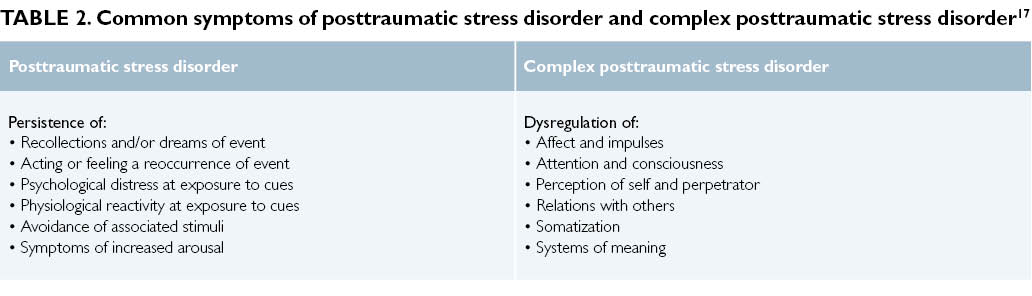
Most recently, DSM modifications for PTSD included a subtype group for children aged younger than 6 years. Research has shown when diagnostic criteria that are sensitive to child developmental stages were used, together with an appropriate behavioral assessment, more children qualified for a diagnosis of the child PTSD subtype than any other PTSD groups.
Child PTSD evaluation include a lack of verbal skills in reporting abuse and the manner in which trauma-related symptoms and memory are expressed. For example, decreased interest in routine activities and play or “restricted play” are considered, and severe temper tantrums are noted to represent increased arousal behavior.
Other childhood signs of PTSD include “loss of interests, restricted range of affect, detachment from loved ones, and avoidance of thoughts or feelings related to the trauma.” These symptoms are typical for children but are less distinct in adults with PTSD.
In short, victims of childhood trauma exhibit many symptoms of PTSD, including dissociation, guilt, and hopelessness, but the diagnostic criteria for PTSD does not accurately include all the important indicators of DTD. Developmental Trauma Disorder: the effects of child abuse and neglect by Maureen V. Kilrain, MS, PA-C
Edited to add: Something we often forget is that we, the parents, can experience PTSD or Secondary PTSD. Working with children with trauma and/or attachment issues can be a very traumatizing experience. It can also trigger issues from our own past that we may have thought we had dealt with long ago. Please get help for yourself and take care of you! Parents get overwhelmed too. If we ignore ourselves and give until there is nothing left then we can no longer function as parents or even just as people.
Some resources: http://www.psychologytools.org/ptsd.html
What Worked for Us
My children have many overlapping diagnoses, and what works for one doesn't always work for the other, but here are some of the things we've found to help when adopting an older child with known Complex PTSD (C-PTSD):
Therapists
Get a good therapist who understands and has experience working with adopted/foster kids with trauma. We love our EMDR therapist for our daughter but still use a good attachment therapist too.
NOTE: Don't be afraid to "fire" the therapist if it's not a good personality match.
EMDR Therapy
EMDR is the most recommended therapy for people with PTSD. It is most often used by soldiers and victims of trauma (like rape or being in a natural disaster), and usually only requires 2-3 sessions.
Obviously, people who have suffered from long-term trauma (Complex PTSD), such as child abuse, would most likely require more sessions.
Medications
There are no meds specifically for treating PTSD, but with good therapy and meds that help with the symptoms, the child can recognize the effects of the trauma, learn to cope, and move on to dealing with the cause of the trauma.
Overlapping Diagnoses
Don't be surprised if PTSD is not your child's only diagnosis, adopting older children usually means they have more going on then just one issue - attachment disorders, physical and sexual abuse, bipolar disorder, ADHD, FAS/FAE...
Caseworkers will not or cannot tell you all of what caused the PTSD, and often symptoms overlap and appear to be other things. I don't think I've ever heard of a child with RAD that didn't also have PTSD. Here's a good chart for Overlapping Behavior Characteristics.
TRIGGERS
- Puberty
Puberty will exacerbate the problem. Be sure you do everything you can to facilitate attachment before it hits and be ready for some regression. {The Teen Years} - Bedtime
Bedtime can be a huge PTSD trigger, often causing Night Terrors and nightmares. Our son frequently has trouble going to sleep, sleeping through the night, and during a particularly bad period, would wake up with his heart pounding and his body shaking all over (his central nervous system releasing stored memories). His "nightmares" of the devil were so real he thought they were visions. Hubby and I took turns sleeping near him for a week. {Sleep Issues} - Projecting on Others (especially parents)Be prepared for your child to blame you for their past. My daughter recently admitted to seeing one of her past abuser's face everywhere - on walls, and particularly - over my husband's face. She hates "him," rages at him, tells him he is mean and evil, accuses him of yelling at her (even though Hubby isn't even raising his voice) and dissociates.
- Stimulating/ Overwhelming Situations
We avoid big groups, noisy places, and in particular, any situation that we know could trigger a flashback. I strongly recommend this, particularly for the first 6 months the child is in your home. Especially avoid the temptation to travel, have a party, introduce your child to everyone, shower him with gifts - he's already dealing with an overwhelming number of changes just by moving into a new home with a new family. - Stimulating Environments
Avoid stimulating events, situations, etc. We have our daughter and son's rooms stripped down to the bare essentials, not just because they've done lots of damage, but because anything more is overwhelming.
Fight/ Flight/ Freeze
When in a meltdown Kitty mentally shuts down - we call it fight, flight, or freeze. She is acting instinctually to protect herself. The thinking part of her brain is not "online."
It's difficult not to hold her accountable when she rages during these times, but we've learned to wait until she's calm and then process what led up to the event so we can help her prevent re-occurrences. There are times when she doesn't remember the meltdown/ rage happening at all. {Handling Rages}
School
Some suggestions for dealing with schools. PTSD is rarely recognized in schools. My children have behavior issues as well as diagnoses that require an IEP (including OHIs -other health impairment- like ADHD). Once you get an IEP though, you can access behavior accommodations that can really help.
Look for knowledgeable parent liaisons who will help you find the resources and accommodations your child needs. Be aware that no matter how wonderful and helpful the school seems, they usually will not volunteer information, and they may actually discourage you from getting help.
Request an assessment of your child in writing - they have 30 days to respond. Make sure they know you are willing to get or have gotten, in touch with an advocate/ lawyer.
ADVOCATE for your child. NO ONE else is as qualified as you are about your child's needs.
My Top 10ish Things I Couldn't Do This Without
I've written a lot of posts on things like Why Won't My Child Just Behave? and Why Doesn't My Child Feel Safe? maybe one of them will have some ideas for you.
Read Beyond Consequences, Logic and Control. It really helped us understand why our kids act the way they do sometimes (they are SCARED!). I also liked Parenting with Love and Logic - it's for "neurotypical" kids so a lot of it doesn't apply to kids of trauma, but it helped me stay calm!
Prioritizing Yourself, Your Family, and Your Child - In That Order!
Get lots of support and take good care of yourself, your husband and your marriage.
Self-Care
Try to surround yourself with people who "get it." In person is best, but the internet has lots of great parent support groups, including BeTA http://www.momsfindhealing.com/ and Facebook groups like the one I admin - Parenting Attachment-Challenged Children and others like Parenting with Connection.
We as parents often get our own PTSD, CTS (Continuous Traumatic Stress), and Caregiver Fatigue. Please take care of yourself!!
__________________
Kitty - came into our home at 11, now 13 - originally diagnosed with ADHD, ODD, learning disabilities, attachment "issues" and victim of abuse. Now diagnosed with bipolar, attachment disorder, ODD, Complex PTSD, learning disabilities, and victim of abuse.
Bear - Kitty's 1/2 sibling, came into our home at 13, now 15 - originally diagnosed with PTSD, conduct disorder, victim of abuse and mood disorder. Now diagnosed with bipolar, RAD, ADD, PTSD, cerebral dysrhythmia, and victim of abuse.
__________________
Sunday, February 8, 2009
PTSD and stomach flu

So after we left Kitty's therapy I got an idea. I decided to let Kitty go to the mall with a pretend $100 (our estimate of the amount of money a foster parent would have to buy clothes for a new child – I would hope it’s more, but I wanted to make a point to Kitty). She would have to buy a week’s worth of clothes including shoes and undergarments with this money. Then we’d go to Walmart and do the same thing. We don’t need to go to thrift stores because we already know what $100 would buy there. Kitty was very excited about this idea.
Of course Friday night I came down with stomach flu and spent all weekend in the restroom or flat on my back. Ponito was finally better so he and the other kids all went to Grandma’s house to spend the night Saturday night. At some point during the weekend, Kitty told Grandma that she has been seeing one of her step-father’s faces everywhere -on walls, on Hubby’s face (which explains her extreme reaction on Friday). I’m worried about the fact that she didn’t feel comfortable about telling me. She was probably afraid I wouldn’t allow her to go to school, the school dance (she wasn’t allowed to go anyway) or would make her take more therapy. This has been going on for a week and sounds like PTSD hallucinations to me. She did give me lots of hugs Sunday afternoon and made sure that Grandma told me about the hallucinations.
Kitty started throwing up tonight (Sunday) so feels pretty horrible (she’d just taken her night meds so I know they didn’t stay down). I’m assuming she’ll be better in time for therapy on Tuesday. The actual vomiting has only lasted about 4-6 hours at most – and then recovering takes 2-3 days.
My anti-social Bear is the only one who hasn't gotten it. Maybe he won't.
Subscribe to:
Posts (Atom)